Doctoral Programme of the Lisbon Academic Medical Centre – Ph.D. CAML
The Lisbon School of Medicine (FMUL), the Institute of Molecular Medicine (IMM) and the Santa Maria Hospital (HSM-CHULN) created a joint Doctoral Programme: Doctoral Programme of the Lisbon Academic Medical Centre (CAML). A programme centred on research projects of excellence, which includes a flexible training component by modules.
The CAML Ph.D. Programme seeks motivated candidates to pursue research in one of the following branches (and in their respective specialties): Biomedical Sciences; Medicine; and Health Sciences and Technologies.
Our mission is to enable candidates to develop independent and original research projects and to promote critical thinking. Be part of the research community of the Academic Center for Medicine, here you will find the theoretical, methodological and experimental foundations necessary for you to develop your research project.
5 reasons to choose this program
1.
Faculty with an intense multidisciplinary scientific research activity and quality that is recognized nationally and internationally and associated with relevant national and international research networks and clinical references
2.
The network of contacts, diversity of projects, research protocols with national and foreign entities that provide students with opportunities to develop integrated research in teams and contexts of high scientific demand, in addition to opportunities for internship and integration in companies after finishing the course, resulting in the registration of patents, theses developed in a business environment and even some cases of business creation
3.
Flexibility in adapting the curricular structure to the needs of each student, in the context of their doctoral project
4.
Success at quality level of scientific publications resulting from the work of the students of the Program, which greatly contributes and is reinforced by the success in accessing competitive funding through national and international projects, in a clear mechanism of positive feedback
5.
Consolidation and institutionalization of the Doctoral Program over the years, both in terms of its relationship with the scientific community and in terms of its internal processes and dynamics
Applications to PhDCAML are permanently open
Pre-application
If you do not yet have a project and an advisory team you may submit a pre-application at any time during the year by sending a letter of intent (outlining your motivation and research interests) and a Curriculum Vitae to the email address camlphd@medicina.ulisboa.pt
The Scientific Committee will assist candidates to find the necessary conditions for the development of their PhD project. We believe that each project is unique and therefore we propose to follow the candidates in a personalized way.
Application
To apply for Doctoral Program of Lisbon Academic Medicine Center you must have the scientific supervision or co-supervision of project by an FMUL professor or researcher.
The application is made exclusively through the portal académico, and does not dispense with consulting the announcement.
The formalization of application is made in Fénix with submission of the following documents (CV and project template should be downloaded from the platform after initial registration):
- Personal Statement justifying the option to apply (addressed to FMUL's President of Scientific Council).
- Declarations of thesis supervisor or supervisors with reference to the conditions of reception and execution of the project, explaining the degree of innovation and the potential of the project to generate publications in indexed journals. Supervisor or co-supervisor, with a maximum of 3 elements in the supervision team, must be connected with the University of Lisbon, preferably with FMUL.
- Summarized Curriculum Vitae of supervisor and co-supervisors, whenever applicable, with reference to publications relevant to the project.
- Proposed Thesis Committee
The Thesis Committee is composed of two elements chosen by the supervisor (preferably one internal and the other external to CAML) and by a third element chosen by the PhD student from among professors/researchers of CAML (preferably with a PhD). This proposal should include the contacts and affiliation of the proposed members.
The tutor can be appointed up to 6 months after approval of the doctoral project by FMUL's Scientific Council. When submitting the application it is only compulsory to present 2 elements proposed by the supervisor.
Click here if you have any doubts about the registration in phoenix or retrieval of credentials.
What you need to know about this program
Lisbon School of Medicine, Instituto de Medicina Molecular (IMM) and Santa Maria University Hospital (HSM-CHULN) recently formed the Lisbon Academic Medical Center, CAML (Ordinance No. 1371/2009 of 27 October), a consortium that aims to promote the development of the academic dimension and excellence in clinical practice, modernization and development of research, medical education and innovation in the health sciences. CAML aims to ensure the essential compatibility of medical education and research with the development of the care mission, renewing the concept of university hospital.
As part of this consortium, FMUL, IMM and HSM-CHLN have designed a joint doctoral program: the CAML Doctoral Program. A program focused on excellent research projects, which includes a flexible and modular training component.
The CAML PhD Program, being research-oriented, aims to stimulate clinicians to ask new questions regarding patients and diseases and to bring them into the laboratory. And reciprocally to bring questions from the laboratory into clinical practice. By bringing together medical and non-medical researchers, the program stimulates new collaborative approaches and more effective communication between basic and clinical researchers.
The three institutions, FMUL, IMM and HSM-CHULN, actively participated in the design of the PhD Program, using existing resources and creating new synergies to create an attractive and motivating environment for clinicians and researchers to develop their PhD theses. The program is managed by a Board of Directors and a Scientific Committee, both composed of representatives from the three institutions.
You can consult its constitution HERE
Tasks of the Scientific Committee:
- Assessment of training programs and credits, assessment of training books;
- Assessment of accreditation processes;
- Monitoring the selection process and the candidate's curricular path;
- Assessment of the scientific research projects for the Thesis and the admissibility of the final thesis;
- Preparation of the Scientific Council Advice.
Todas as decisões relacionadas com estas competências estão sujeitas à ratificação pelo Conselho Científico.
All decisions related to these competences are subject to ratification by the Scientific Council.
You can consult the calendar of monthly meetings of PhDCAML and the Scientific Council here.
The CAML PhD programme includes a PhD Students’ Committee composed by student representatives of each CAML institution:
- Biomedical Sciences
- Medicine
- Health Sciences and Technologies.
This Committee is composed of representatives elected each year by the corresponding student community. The representatives serve as mediators between the CAML community and the Board of Directors of both the PhD programme and of each CAML member institution. Therefore, the PhD Students’ Committee focuses on creating a communication platform where students can voice their concerns and suggestions. To this end, the Committee participates in some initiatives, such as making a Slack channel and an Academic available to all doctoral students, and scheduling regular meetings with students to understand the priority action points.
In addition to the PhD Students’ Committee, the PhD CAML also includes frequent opportunities for scientific discussion organized and moderated by the students. Volunteers are recruited every year to organize seminars with internal and external speakers. Thus, CAML PhD students are the ones who maintain the regularity of:
- Monday Lectures
- Pizza Seminars
- Annual CAML PhD meeting
- between others.
To contact the 2023-2024 Course Committee:
CAML PhD Program, being research-oriented, aims to stimulate clinicians to ask new questions regarding patients and diseases and to bring them into the laboratory. And reciprocally to bring questions from the laboratory into clinical practice. By bringing together medical and non-medical researchers, the program stimulates new collaborative approaches and more effective communication between basic and clinical researchers.
The program intentionally emphasizes research and proposes a very flexible curricular structure that can be adapted to candidates from different medical and related fields as well as allowing students to choose between a full or partial time commitment. Individual pathways are thus created, which best suit the profiles of the doctoral candidates.
During their PhD, candidates are followed by a supervisor and a Thesis Committee. The Thesis Committee is responsible for monitoring and analyzing the progress made by the student. It is composed of 2 members proposed by the supervisor, preferably one from the host institution, who are experts in areas related to the thesis topic and a third member, the Tutor, chosen by the student from among senior researchers. The Tutor has a role of provider and must monitor the institutional integration and the development of the scientific culture of the doctoral student.
The PhD Program is composed of:
An Advanced Training component equivalent to 1 semester (corresponding to 30 ECTS) with a modular structure ("student-oriented"), which can be developed continuously or intermittently during the PhD Program.
e
A Research Project, leading to the presentation and discussion of the Doctoral Dissertation, with a duration equivalent to seven semesters (210 ECTS, including 30 ECTS corresponding to the guidance of the scientific project by the thesis supervisor over the four years).
CAML PhD Regulations
Guide to administrative procedures
Regulation of the CAML PhD Program (in portuguese)
CAML PhD Branches and Specialties (in portuguese)
Under Order No. 6665/2011, creation of the PhD Program of Lisbon Academic Medical Center, during their PhD, candidates are accompanied by a guidance team and by the Thesis Committee and tutor. The Thesis Committee (TC) has the role of monitoring and analyzing the progress made by the student. The Tutor has an ombudsman role and must monitor the institutional integration and the development of the scientific culture of the doctoral candidate.
See in detail the notes on the organization of the TC:
Download 1st year, 3rd year and the follow-up TC reports (if applicable).
The annual renewal of registration is mandatory and takes place at the academic office fénix within the deadlines established annually and published HERE. You can consult the Annual Tuition Fees Order HERE.
Renewal of registration presupposes:
- Submission of the annual report at the fénix academic secretariat - Submission of the PhD Report
Submission from June 19 to 31 july, 2023.
- Declaration of the Supervisor(s) - The supervision team, formally approved by the Scientific Council of FMUL, must issue an opinion, which may be individual or joint.
- Annual Report - Annual presentation of the written report on the progress of the work with the opinion of the guidance team, to be sent annually from June 28 to August 31.
- Reports Thesis Committee - Under Order No. 6665/2011, creation of the Doctoral program of the Academic Centre of Medicine of Lisbon, during their doctorate, candidates are accompanied by a guidance team and the Thesis Committee and tutor. The Thesis Committee (TC) has the role of monitoring and analyzing the progress made by the student. The Tutor has an ombudsman role and must monitor the institutional integration and the development of the scientific culture of the PhD candidate. The TC reports for the year in question must be attached, if applicable, 1st year, 3rd year and interim report if applicable.
- FCT Grant Renewal - FCT grant students are required to submit the FCT grant contract or its renewal. The tuition fee will only be waived in Phoenix upon receipt of this document.
Note: If not applicable submit a blank sheet.
- Procedural aspects to be observed
- No debts from previous year;
- Payment of the 1st installment of the academic year in question, or, applicable to FCT scholarship students, submission of the scholarship contract or its annual renewall;
- Submission of the annual written report on the progress of the work with the opinion of the guidance team, to be sent annually from June 1 to August 31 to the email address: camlphd@medicina.ulisboa.pt
- Technical instructions for formalizing registration in phoenix in the tab:
- Student – Enroll - Enrollment processes – Enroll – select “Discussion of the Scientific Project by the Advisor”, save, continue, finish.
- Student – Enroll - Enrollment processes – Enroll – select the "respective year of thesis”, save, continue, finish.
1st year students who do not have a contract with the FCT at the time of enrolment and registration at Lisbon School of Medicine, must send to IFA, to the email address camlphd@medicina.ulisboa.pt, a document proving that they were considered eligible for a scholarship.
After formalization of the contract with the FCT, a copy of the contract must be sent for the attribution of the tuition fee exemption generated in the Fénix academic system.
Every year they must request the annual renewal of the scholarship with FCT, sending the documentation and deadlines defined by the FCT:
https://www.fct.pt/financiamento/programas-de-financiamento/bolsas/
The declarations of registration in the doctoral program for the purpose of the FCT scholarship renewal are issued by IFA, after request by the student.
- Doctoral Interns
The maintenance of the doctoral intern status depends on the submission of annual reports prepared by the doctoral intern and confirmed by the doctoral supervisor and the person responsible for training, attesting to the fulfillment of the established objectives.
The annual reports are sent annually by the student, before the renewal date, to IFA, ACSS, FCT, Internato Medico.
Failure to submit the annual report or submission of a report with missing documents may result in the loss of the status of doctoral intern.
Note: This information does not exempt the consultation and observation of the rules defined by FCT and ACSS.
- FCT training costs
Students benefiting from exceptional FCT scholarships for the mitigation of covid-19 may request the use of the remaining amount of the training costs of the 5th year scholarship, in accordance with the procedures defined in order 5474/2021 of June 1.
The requests mentioned in order 23/2021 are made on FMUL website, with the indication of request under "PROJECT" and reference "in this field put the reference of the FCT scholarship".
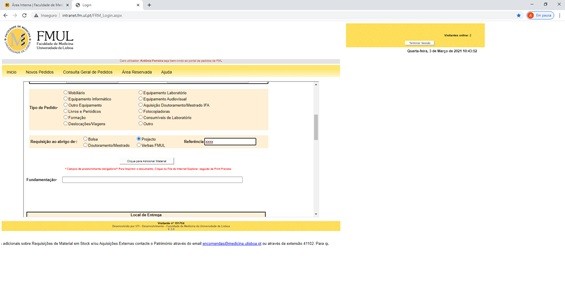
Requisitions are accompanied by budgets and a letter from the supervisor justifying the acquisition within the scope of the ongoing PhD project.
The FMUL Finance Department is in charge of validating requisitions and managing funds, with the contact e-mail address address financeira@medicina.ulisboa.pt.
The instruction of the process is carried out in the academic portal fenix candidate area, with the completion of all tabs and submission of the following documents:
- Proposal for writing the thesis - Provisional Version
- Updated summary of the Curriculum Vitae, with reference to indexed publications (2 to 5 A4 sheets);
- Abstract of the thesis (the thesis must include abstracts in Portuguese and in another official language of the European Union, with a minimum of 300 words each, up to 5 keywords in Portuguese and in another official language of the European Union, and indexes).
When, according to the specific regulations, the thesis is written in a foreign language, it must be accompanied by a more developed abstract in Portuguese, with a length of between 1200 and 1500 words.
- Supervisor(s) advice(s) on the final draft of the Thesis (2 copies - 1 A4 sheet).
- Submission of dated and signed Thesis Committee reports.
- Formative booklet signed by the supervisor(s).
Supporting documents:
The instruction of the process is carried out at the Advanced Training Institute (IFA) with the submission of documents, in pdf format. by email sharing Dropbox, Google Drive or WeTransfer link to the email address: provas.academicas@medicina.ulisboa.pt
Required documents:
- Application addressed to FMUL's President of the Scientific Council requesting the scheduling of PhD exams.
- Payment of the fee of € 500 according to the table of fees in force, consult the personal area of the fénix academic secretariat
- PhD Thesis; Curriculum Vitae; PhD Thesis Summary
- Declaração de cedência de dados
Internal rules to be observed on the inside cover of the thesis
By express determination of FML Director (order-48/2004), for the purposes of printing the PhD thesis, all volumes must contain on the inside cover the following statement, in bold and body 14, on the inner 1/4 of that page:
"The printing of this thesis was approved by Lisbon School of Medicine Scientific Council at a meeting on (date of approval)."
Supporting documents::
Thesis Approval
The thesis is final after the tests have been completed (when no corrections have been requested) or after the President of the Jury has confirmed that the requested corrections have been made.
Documents to be submitted:
The candidate has, after the test, 30 working days to deliver, under the terms of article 46 D, of Decree-Law no. 65/2018, 1 copy of the thesis on paper for the purpose of the legal deposit provided for in paragraph 4 of article 50 of the same decree-law.
It is also necessary to deliver it in digital pen-drive format:
3 copies of the definitive thesis;
1 curriculum vitae;
1 copy of the provisional version of the thesis;
The formatting of the cover of the definitive thesis follows the same criteria defined in the formatting of the provisional cover excluding the designation "provisional version".
To be available soon
Advanced Course Programs
CAML's Doctoral program stands out for its individualized and flexible path. Its organization is centered on the doctoral student and his/her research project.
The main objective is to enable doctoral students to develop original research projects, enhanced by a unique academic research and care climate, which includes clinical and non-clinical researchers, in an integrative concept involving clinical, biomedical and health sciences and technologies.
The curricular structure of the Doctoral program, can be completed over the four years of doctoral studies, for a total of 30 credits, see course booklet.
Core Courses
Information Literacy Training Program
Course Date: To be determined
Coordination:
Professor Mamede Carvalho
Professor João Costa
Dr. Susana Henriques
Place: to be announced
ECTS: 2 ECTS
Applications: To be determined
Fees: Master/PhDStudents FMUL– Free
External Students: 300€
Core Courses
Ethics for Research
Coordination
Professor Doutor Luís Madeira
Course Date: June 17th to June 28th
Place: Egas Moniz Building, Room 48, Floor 01
ECTS: 2 ECTS
Applications: April 8th to May 19th
Fees: FMUL/CAML PhD Students - Free
CAML Applicants (IMM/FMUL/ULSSM) – 75€
Other Applicants – 100€
Workshop
Biobancos: potenciar a investigação em saúde
Data do Curso: A realização do curso está prevista setembro 13 a 15 de setembro, das 09h00 às 17h00
Coordenação: Prof. Doutora Brígida Riso, FMUL e Biobanco -iMM
Local: a definir
ECTS: 1 ECTS
Candidaturas 1ª Fase: 07 de junho a 21 de julho
Fees: FMUL/ PhD Students – Free
Outros estudantes: 100€
Profissionais: 250 €
Candidaturas 2ª Fase: 24 a 30 de agosto
Fees: FMUL/ PhD Students – Free
Outros estudantes: 150€
Profissionais: 300 €
Useful Information
Applications will be submitted on https://fenix.medicina.ulisboa.pt
Applicants who already have a @campus.ul.pt account (who are attending or have attended a course at the Faculdade de Medicina), must start the application at https://fenix.medicina.ulisboa.pt/application.
To access must log in with the Campus account and then access the Candidate menu (at the top of the page) to start the application.
If you don’t remember the username or password of the account click HERE and follow the instructions for the recovery of the username or password. If you cannot retrieve your username or password trough the recovery mechanism, you should send an email to the address suporte@medicina.ulisboa.pt with the following data: full name; student number; course number identification; ID number (BI/CC); External email.
Applicants who do not have a @campus.ul.pt account (Fenix) should register HERE. After creating your account you will receive in your email the username after which can start the formalization of the application in https://fenix.medicina.ulisboa.pt.
For further questions please contact: camlphd@medicina.ulisboa.pt
CD4 T cells and the lung immune network
Carolyn King | Suíça
29th July, 2024 – 12:30pm
Location: Egas Moniz Building – Floor 0 – Auditorium 52 (David Ferreira Auditorium)
Regulation of HIV-1 transcription: implication in cure Strategy
Monsef Benkirane | França
08th July, 2024 – 12:30pm
Location: Egas Moniz Building – Floor 0 – Auditorium 52 (David Ferreira Auditorium)
Uncovering epigenetic and transcriptional interplay regulating axonal regeneration
Radhika Puttagunta | Alemanha
24th June, 2024 – 12:30pm
Location: Egas Moniz Building – Floor 0 – Auditorium 52 (David Ferreira Auditorium)
Nuclear structure, function and homeostasis – from ribosome synthesis to chromatin organization
Ulrike Kutay | Suíça
17th June, 2024 – 12:30pm
Location: Egas Moniz Building – Floor 0 – Auditorium 52 (David Ferreira Auditorium)
Exploiting glycosylation against viral diseases
Aitor Casas-Sánchez| UK
03rd June, 2024 – 12:30pm
Location: Egas Moniz Building – Floor 0 – Auditorium 52 (David Ferreira Auditorium)
Exploring Trypanosoma brucei antigenic variation in high resolution
Monica Mugnier| USA
27th May, 2024 – 12:30pm
Location: Egas Moniz Building – Floor 0 – Auditorium 52 (David Ferreira Auditorium)
The spliceosome in health and disease
Daniel R. Larson | USA
20th May, 2024 – 12:30pm
Location: Egas Moniz Building – Floor 0 – Auditorium 52 (David Ferreira Auditorium)
Remote Control: How Intracellular Parasites Take Over Your Cells
Moritz Treek | Portugal
13th May, 2024 – 12:30pm
Location: Egas Moniz Building – Floor 0 – Auditorium 52 (David Ferreira Auditorium)
AI for antibiotic discovery
César de La Fuente | USA
29th April, 2024 – 12:30pm
Location: Egas Moniz Building – Floor 0 – Auditorium 52 (David Ferreira Auditorium)
Energetics of metabolism in unicellular organisms
Pablo Sartori| Portugal
08th April, 2024 – 12:30pm
Location: Egas Moniz Building – Floor 0 – Auditorium 52 (David Ferreira Auditorium)
3D matters – genome reorganization during adipocyte differentiation
Philippe Collas | Norway
11 March, 2024 – 12:30
Location: Egas Moniz Building – Floor 0 – Auditorium 52 (David Ferreira Auditorium)
In vitro production of cat-restricted Toxoplasma pre-sexual stages by epigenetic reprogramming
Hakimi Mohamed-ali | France
19 February, 2024 – 12:30
Location: Egas Moniz Building – Floor 0 – Auditorium 52 (David Ferreira Auditorium)
From protein localization patterns to the understanding of how epithelial cells move and divide
Eurico Morais de Sá | Portugal
5 February, 2024 – 12:30
Location: Egas Moniz Building – Floor 0 – Auditorium 52 (David Ferreira Auditorium)
Optimizing sepsis immunotherapies: the crucial role of biomarker-based patient stratification for individualized treatment
Guillaume Monerret | France
29 January, 2024 – 12:30
Location: Egas Moniz Building – Floor 0 – Auditorium 52 (David Ferreira Auditorium)
In-depth analysis of the skin neuro-immune ecosystem: from basic science to drug
Nicolas Gaudenzio | France
15 January, 2024 – 12:30
Location: Egas Moniz Building – Floor 0 – Auditorium 52 (David Ferreira Auditorium)
What gastruloids tell us about development and evolution
Alfonso Martinez-Arias | Spain
8 January, 2024 – 12:30
Location: Egas Moniz Building – Floor 0 – Auditorium 52 (David Ferreira Auditorium)
Coordination


Accreditation